
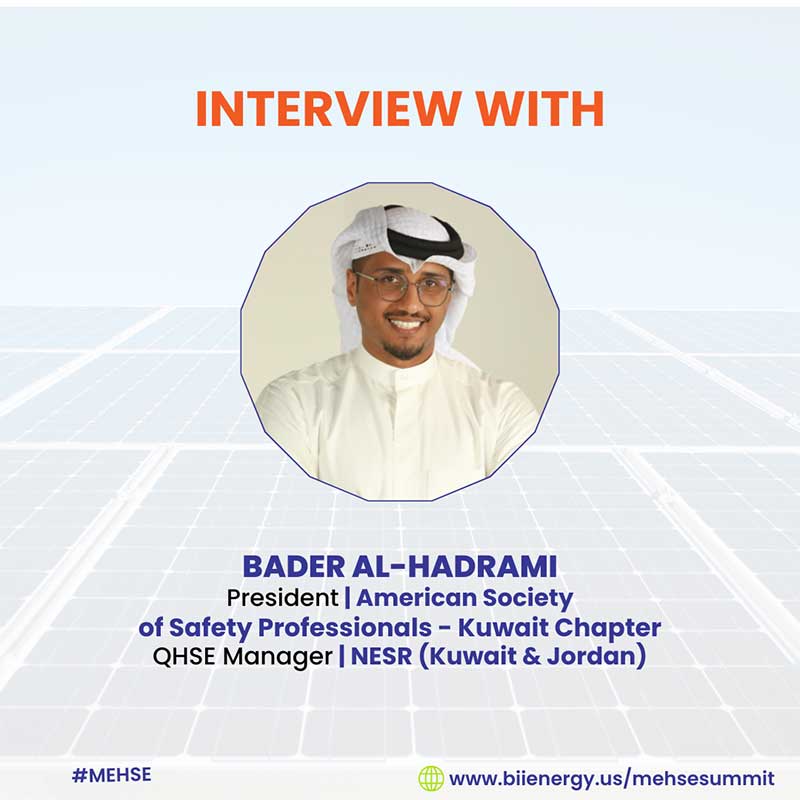
1. How do you define “excellence” in Safety, Health, and Sustainability specifically within the Middle Eastern energy sector—and how does it differ from global benchmarks?
Excellence in our region means moving beyond compliance to a proactive culture with an aligned safety leadership. In the Middle East, particularly the energy sector, we operate with high-risk operations, diverse workforces, and extreme environments. Excellence here involves integrating behavioral safety, local culture, and technology—while also ensuring workforce empowerment at every level.
Through the ASSP Kuwait Chapter, we’ve seen that when regional practices, like heat stress adaptation, cross-cultural communication, and contractor safety integration, are formalized and measured, they don’t just meet global benchmarks, they influence them.
2. The summit emphasizes AI, digital transformation and cybersecurity in HSE. Which of these technologies do you believe will have the greatest impact in the next 2–3 years in the region—and why?
Digital transformation in safety, particularly the use of AI-driven analytics and connected worker technologies will have the most immediate and scalable impact in our region.
we’re seeing growing interest in real-time safety dashboards, predictive risk modeling, and mobile-based safety engagement tools. These tools enable early intervention, empower the workforce, and bridge language/cultural gaps, something especially critical in the GCC’s multinational sites.
3. Can you share a case study or initiative from your organization in areas such as process safety, risk management, or workforce well‑being that illustrates measurable progress?
Through the ASSP Kuwait Chapter, we launched a GCC Excellence award program that recognizes organizations for demonstrable improvements in systems, behavior, and innovation. One initiative involved a company reducing incident rates through micro-learning safety videos in multiple languages, a simple but scalable solution.
From a personal role, at NESR we integrated a human-centered hazard reporting system that led to a 40% increase in near-miss reports transforming reporting from a compliance task into a cultural habit.
4. With evolving ESG frameworks and stricter regulations in the Gulf, what do you see as the biggest compliance or implementation challenge—and what strategies have you found effective?
The main challenge is bridging strategy with field-level execution. ESG goals are often set at the boardroom level, but their translation into frontline behavior is inconsistent.
What works is aligning ESG indicators with safety culture metrics—for example, measuring contractor well-being, not just emissions.
Another key strategy: stakeholder engagement from the start—especially involving contractors and community voices.
5. The energy sector is inherently high‑risk. What leadership behaviours or cultural practices have you found most effective in embedding a resilient, safety-first mindset across all levels?
The most effective leaders are visible, empathetic, and consistent. They actively listen, engage with the workforce at all levels, and treat safety as a shared value—not just a KPI.
Culturally, creating psychological safety—especially for diverse workforces—is essential. At ASSP-Kuwait, we emphasize “speak-up culture,” safety storytelling, and peer-led initiatives to build ownership from the ground up.
Leadership isn’t just about giving direction—it’s about enabling connection and trust.
6. Finally, what key takeaway or challenge would you like delegates to remember and act on after your session during the summit?
Safety excellence is not about checking boxes, it’s about changing behavior, mindsets, and systems. I challenge every delegate to take one bold step: whether it’s piloting a digital tool, reforming contractor engagement, or launching a cultural safety initiative.
Innovation and impact don’t start with large budgets—they start with clear intent and consistent leadership.